Are Plant Growth Regulators Worth the Investment?
Jan 15 2026
How the Right Products Can Turn Early Season Vigor into Proven ROI.
Plant growth regulators (PGRs) have been getting more attention from the agricultural community in recent years, but you may be wondering if they live up to the hype. Placing a biological product in-furrow at planting has benefits, including healthy root growth, faster and more consistent emergence, and improved water and nutrient uptake.
When paired with a starter fertilizer, in-furrow biologicals have been shown to increase yields significantly. For example, up to 7.5 bushel-per-acre-yield advantage in corn1 when using Ascend2® PGR. If you haven’t added a PGR to your crop nutrition program, now may be the time to start.
What Do PGRs Do?
PGRs are hormones that regulate the growth and development of plants. Jon Zuk, crop protection product manager for WinField United explains, “There are five basic classes of plant growth regulators, each with a different effect on plants, ranging from stimulating plant growth to dictating seed germination. Plant responses may vary depending on PGR type, rate and application timing.”
- Auxin: Key regulator of plant growth and development that causes biological responses, such as flower formation, fruit set and growth, and root and stem growth.
- Gibberellins: Regulator of key processes in the plant to stimulate cell division and elongation, break dormancy and speed up seed germination.
- Cytokinins: Plant hormones that stimulate cell division.
- Ethylene: Plant hormone that induces ripening, causing leaves to droop and drop(often a result of stress).
- Abscisic acid: Plant-growth inhibitor that induces dormancy, prevents seed germination and causes stomata to close.
Zuk notes, “The Ascend PGR lineup by WinField United includes products that can be applied as a seed treatment, in-furrow or a foliar application for season-long plant health benefits. Each Ascend PGR is formulated with an optimal blend of auxin, cytokinin and gibberellic acid to boost plant health and enhance stress tolerance.”
Ascend2® PGR is an auxin-dominant formulation that promotes vigorous emergence and root development in corn. When combined with a starter fertilizer, Ascend2 PGR offers a simple, convenient way to enhance early season crop growth and stress tolerance. Based on multiple years of WinField United Answer Plot® trials, corn treated with Ascend2 PGR in-furrow along with a starter fertilizer had a 7.5 bu/A yield advantage compared to crops that only received a starter fertilizer.1
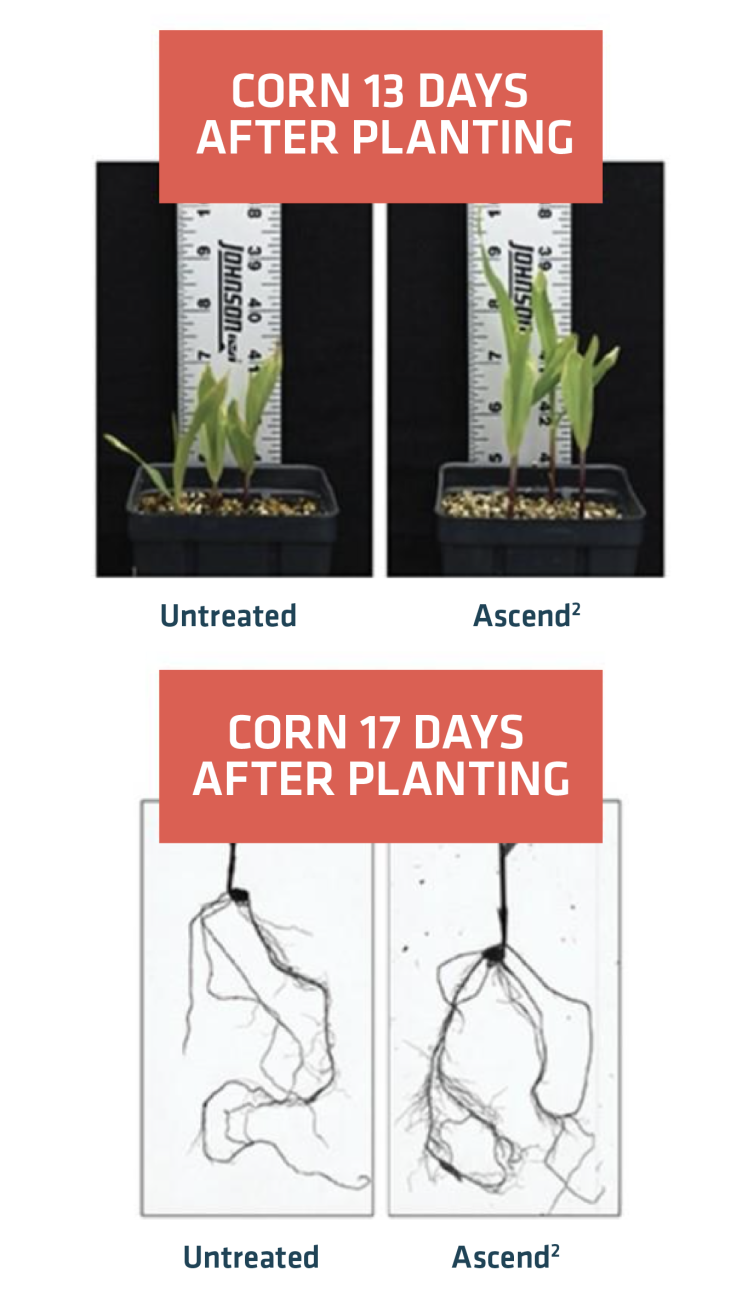
The plant hormones in Ascend2 PGR regulate plant growth and development, leading to significant benefits, including larger corn root masses with more root hairs. They can also help promote vigorous emergence, wider leaves and thicker stalks.
Packed with the same trio of powerful plant growth regulators, auxin, gibberellic acid and cytokinin, Ascend® ST3™ PGR is the latest innovation, crafted specifically as a seed treatment. For growers seeking an alternative application method without sacrificing performance, Ascend ST3 delivers all the proven benefits of Ascend in a convenient, seed-applied format.
When Should You Apply a PGR?
“PGRs can be applied throughout the growing season,” Zuk says. “To promote vigorous root growth and early emergence, PGRs may be utilized as a seed treatment or in-furrow at planting. The benefit of using a PGR before emergence is seeds get an extra boost and a strong start when soil and environmental conditions might not be favorable.”
“Applying a foliar PGR before corn tasseling can help stimulate plant growth and development to harness more energy for grain fill,” explains Zuk, “An application at V4 to V6 in corn makes sense because you’ll have a better idea of your crop’s yield potential and can focus PGRs where you’ll get the best potential return on investment.”
Aren’t All PGRs the Same?
Well, not quite. Zuk explains, “PGR is a broad term for any product that uses plant hormones to generate a plant response. PGRs can initiate many plant responses, from more vigorous root growth and stem elongation to plant senescence; therefore, not all products provide the same results. Before you invest in a PGR, be sure you know what the active ingredients are and what the expected plant response is.”
It is important to remember more active ingredient does not always mean a better plant response when applying PGRs. Always ask for firm data to back up any product claims. The Answer Plot research program has generated solid data supporting the benefits of applying PGRs as treated seed, in-furrow at planting or later in the season as a foliar application.
1Based on more than 60 trials across Answer Plot locations in 15 states from 2017-2021.